The Poetry and the Politics: Radical Reform in Victorian England by Gregory James & James Gregory
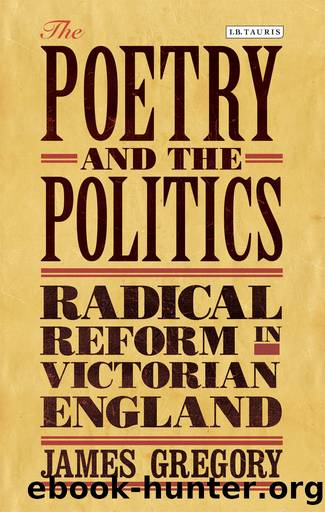
Author:Gregory James & James Gregory [James, Gregory & Gregory, James]
Language: eng
Format: epub
Tags: Great Britain, History, Europe, General
ISBN: 9780857724953
Google: 1eeKDwAAQBAJ
Publisher: Bloomsbury Publishing
Published: 2014-10-10T12:12:18+00:00
In late April 1849 Duncanâs presence was reported in the Northern Star, at the Chartist journalist Edmund Stallwoodâs lecture on the writings of Thomas Paine at the Assembly Rooms, 21 Golden-lane, Cripplegate, supporting a motion of thanks to the lecturer, and reciting an ode in memory of Paine, who had died in 1809.78 Paine, part of the inheritance of metropolitan radicalism, gave his name to one metropolitan Chartist âlocalityâ, and was the subject of a lecture by Thomas Cooper in aid of the Chartist victim fund, in early 1849, an anonymous poem in the Northern Star, a biography published by William James Linton, and a birthday festival at John Street Institute.79 An anonymous poem, but written by William Edmonstone Aytoun, entitled âThe Golden Ageâ, which was published in Blackwoodâs Edinburgh Magazine in 1852, recalled: âWith gibbering glee the ghost of Thomas Paine | Heard the old watchwords thrill the streets again, and eager Chartists murmured as they ran | âThe Age of Reason and the Rights of Man!ââ (the poet also mentioned the London minstrels, âshriningâ the âfoul Megaeraâ in their lays).80
On 23 July 1849 Duncan attempted to address a meeting at the London Tavern in Bishopsgate Street in the City, a popular venue for public meetings, which was intending to consider the âpresent condition of Hungaryâ: Richard Cobden, Lord Nugent, Lord Dudley Stuart and other Liberal MPs, were on the platform, to respond to the âinterference of a neighbouring power with an independent nationâ. Unfortunately, Duncan, and the Chartist leader and writer G.W.M. Reynolds, decided to interrupt and interfere with this meeting â Reynolds to discuss the political divisions in Britain, Duncan to mount the platform â and the chairman, Reynolds, and Duncan in vain endeavoured to obtain a hearing together. The Era declared it âthe most turbulent meetingâ ever held in the City of London. It was, in fact, âa complete bear garden from beginning to end,â with Cobden, the Liberal MP Ralph Bernal Osborne and others, leaving the meeting at the height of the disturbance.81
Duncan was absent from the newspapers for several months after that â perhaps involved in the production of his journal The Divinearian. Then, in 14 January 1850 he was again causing disarray at an evening meeting, this time the first metropolitan gathering of the National Charter Association at the London Tavern: the venue filled with working men and their wives (âcarrying in their arms infants of tender yearsâ) and, âto judge by their bearded visages, ⦠a few foreign sympathizers,â with Feargus OâConnor taking the chair.82 After various addresses were given, by Reynolds, Philip MâGrath, William John Vernon (the forty-year-old lecturer in mesmerism and phrenology imprisoned in 1848, who had just been released83), George Julian Harney and Samuel Kydd, Duncan had leapt up on his chair in front of the platform, perhaps stimulated by Harneyâs sanguine comments on French red republicanism (Harney launched the journal Red Republican in that year), âand with his arms thrown out and his eyes staring wildly over an
Download
This site does not store any files on its server. We only index and link to content provided by other sites. Please contact the content providers to delete copyright contents if any and email us, we'll remove relevant links or contents immediately.
4 3 2 1: A Novel by Paul Auster(12511)
The handmaid's tale by Margaret Atwood(7832)
Giovanni's Room by James Baldwin(7435)
Big Magic: Creative Living Beyond Fear by Elizabeth Gilbert(5833)
Asking the Right Questions: A Guide to Critical Thinking by M. Neil Browne & Stuart M. Keeley(5831)
Ego Is the Enemy by Ryan Holiday(5527)
The Body: A Guide for Occupants by Bill Bryson(5177)
On Writing A Memoir of the Craft by Stephen King(4997)
Ken Follett - World without end by Ken Follett(4789)
Adulting by Kelly Williams Brown(4622)
Bluets by Maggie Nelson(4604)
Eat That Frog! by Brian Tracy(4597)
Guilty Pleasures by Laurell K Hamilton(4503)
The Poetry of Pablo Neruda by Pablo Neruda(4167)
Alive: The Story of the Andes Survivors by Piers Paul Read(4077)
Fingerprints of the Gods by Graham Hancock(4050)
White Noise - A Novel by Don DeLillo(4045)
The Book of Joy by Dalai Lama(4037)
The Bookshop by Penelope Fitzgerald(3900)
